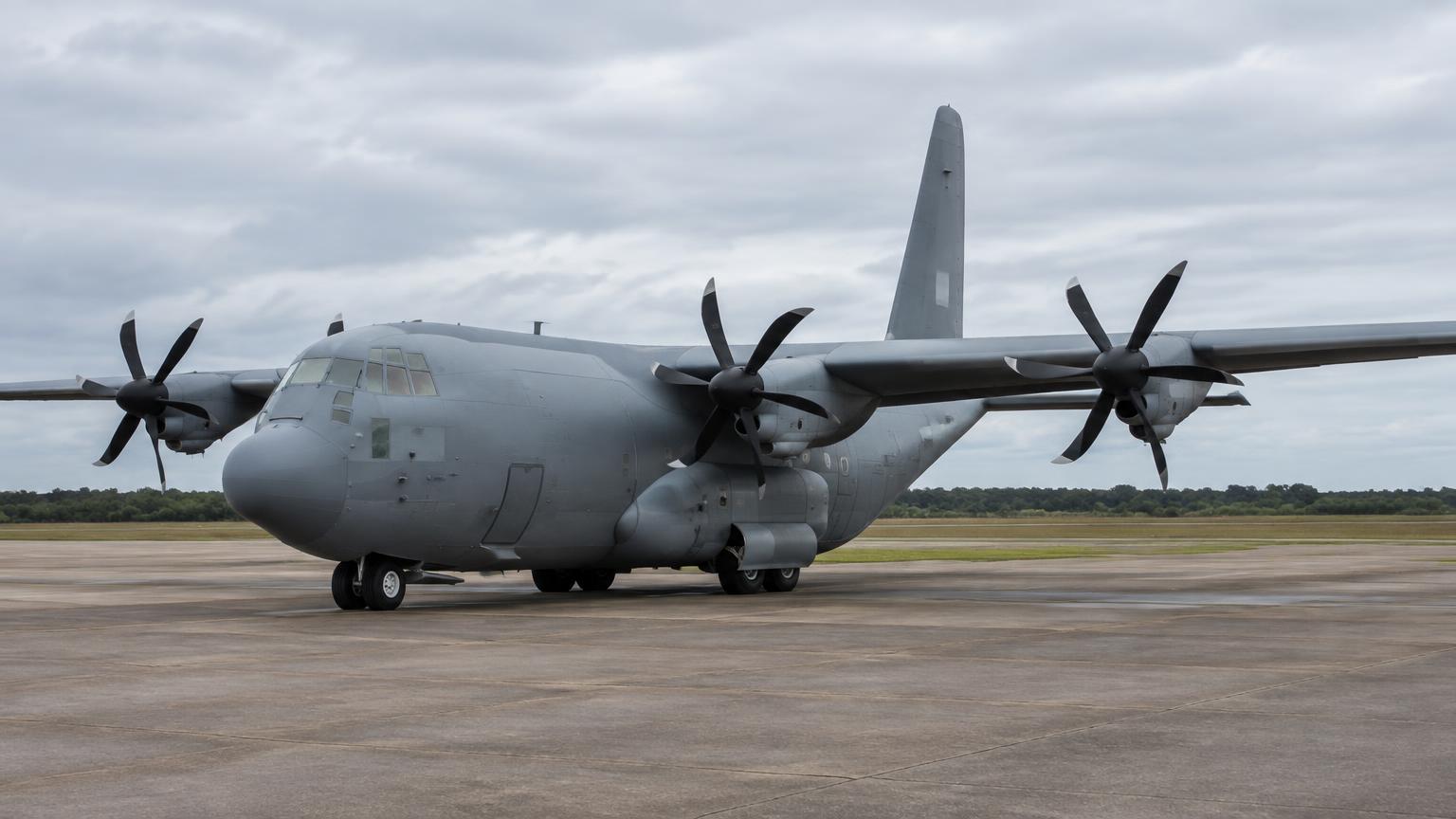
Lockheed Martin · Four-engine military/utility turboprop transport
Lockheed Martin C-130J Super Hercules
A four-engine, high-wing tactical airlifter that can land on short, rough strips and drop cargo or paratroops from the air.
Unverified — check your manualText on this page is written from general knowledge. Figures marked ✓ are checked against official FAA/EASA data.See verified data
Model / variant — applicability
Years
1999 - present
Serials
By line number / operator - see Flight Manual applicability
Engine
4 x Rolls-Royce AE 2100D3, FADEC, Dowty R391 6-blade props
Baseline doc
C-130J Flight Manual (TO 1C-130J-1)
✓ Guide content applies
Guide content is written for this baseline C-130J.
Glass cockpit, 2-pilot crew (no flight engineer/navigator), dual HUDs.
approx. 155,000 lb normal (175,000 lb max overload)
Crew
2 pilots + loadmaster (no flight engineer/navigator on the J)
Cockpit
4 colour MFDs, 2 HUDs, dual mission computers
Landing gear
Retractable tricycle, tandem mains into fuselage sponsons
PHOTO TOUR — tap a numbered point
Illustrative AI-generated imagery — panel details may differ from real aircraft
Glass Cockpit, HUDs & Mission Computers
Glass Cockpit, HUDs & Mission Computers
ATA 22 Auto FlightATA 23 CommunicationsATA 31 Indicating / RecordingATA 34 NavigationATA 76 Engine ControlsATA 77 Engine Indicating
A two-pilot glass cockpit with four colour multifunction displays, dual head-up displays (HUDs) and dual mission computers replaces the flight engineer and navigator stations of earlier Hercules models.
How it works
01Four interchangeable colour MFDs present primary flight, navigation, engine and systems data; any display can take over another's data if one fails.
02Dual HUDs project flight path, airspeed, altitude and approach guidance onto the windscreen so pilots can fly heads-up, which matters for low-level tactical flying, airdrop runs and poor-visibility approaches to unprepared strips.
03Dual mission computers run the FMS/CNI-MU (Communication, Navigation, Identification Management Unit), integrating navigation, radios and identification systems and driving the keypads on the centre console.
04An integrated autopilot and autothrottle hold speed, altitude and flight path, including coupled approaches, reducing crew workload on a two-pilot flight deck that no longer carries a flight engineer or navigator.
05Because the aircraft has no flight engineer, engine and systems synoptic pages on the MFDs are designed so either pilot can monitor all four engines and aircraft systems directly.
Key data & limitations
Where to find itC-130J Flight Manual (TO 1C-130J-1) Section 1/7; C-130J maintenance manualCheck this reference in your official manual.
Displays
4 x colour MFDs
HUDs
2 (pilot and co-pilot)
Crew
2 pilots + loadmaster
Maintenance guidelines
Where to find itMaintenance manual, ATA 22 / 23 / 31 / 34 / 76 / 77Check this reference in your official manual.
MFD, HUD and mission computer built-in test (BIT) checks before flight per the C-130J Flight Manual.
Avionics software configuration verified against the aircraft's certified load per the maintenance manual.
Pitot-static and air data system checks at scheduled intervals.
EDUCATIONAL USE ONLY. Content is summarised from manufacturer documentation for learning. It is not approved flight or maintenance data. Always use the current, aircraft-specific POH/AFM, FCOM, QRH, AMM and operator procedures.