Sections menu
Lockheed Martin C-130J Super Hercules · Type data
Variants & history
Dimensions, development milestones and what changed between each version.
The C-130 Hercules was designed in the early 1950s to meet a US Air Force need for a tactical transport that could carry troops and heavy cargo into short, rough airstrips. It has been in continuous production longer than any other military aircraft, and today's C-130J Super Hercules keeps the classic shape while replacing almost everything inside it.
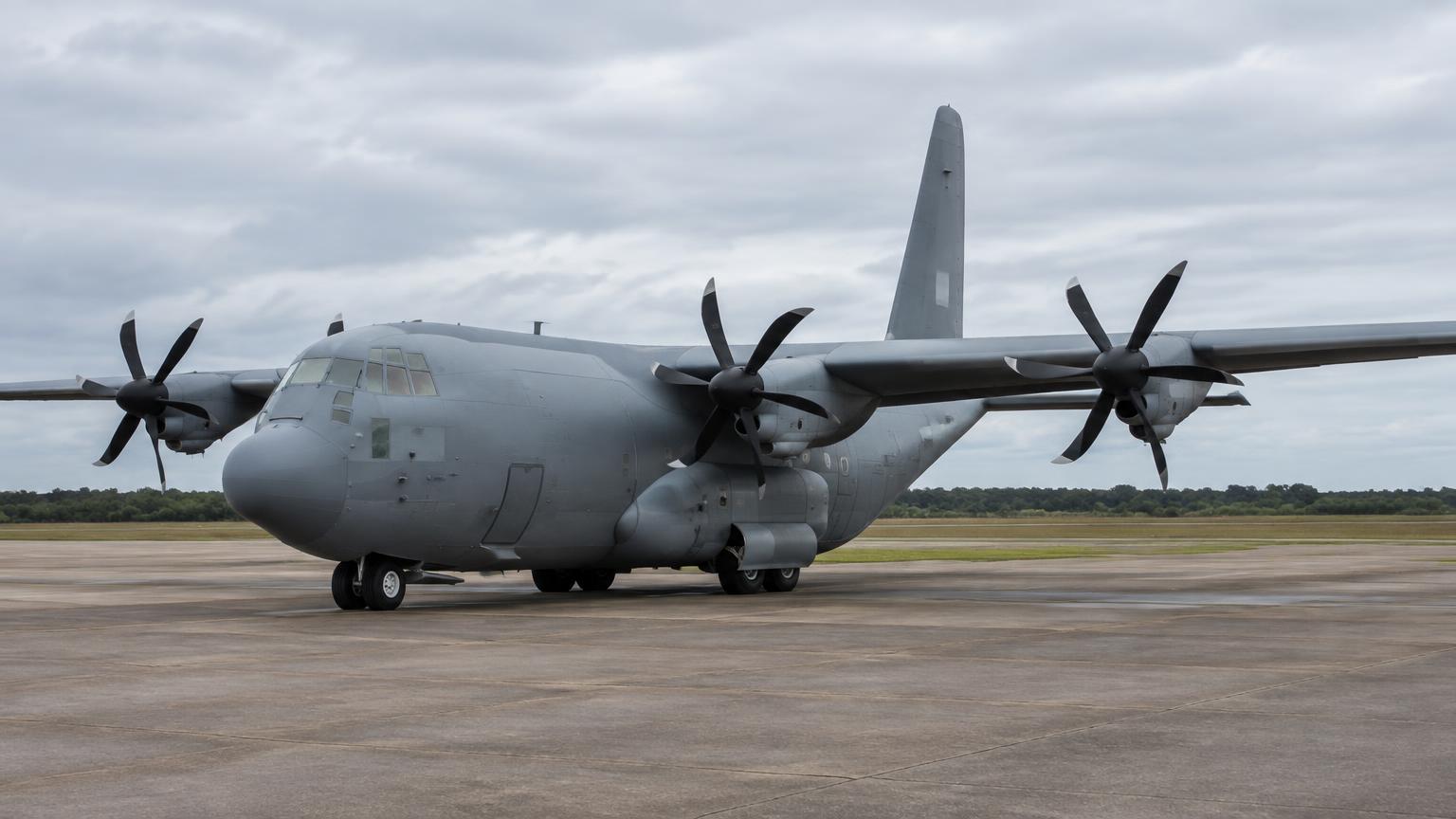
A transport for rough fields
The Korean War showed that the US Air Force had no aircraft able to carry heavy loads into short, unprepared strips near the front. In 1951 it asked for a transport that could carry about 92 troops or bulky cargo, take off from short fields, and fly low and slow for airdrops. Lockheed's design won: a high wing to keep engines and propellers clear of debris, four turboprops, a floor at truck-bed height and a rear ramp that could be lowered on the ground or in flight.
Sixty years of legacy Hercules
The A, B, E and H models kept the same shape while gaining power, fuel and strength. The Hercules flew in Vietnam, landed on an aircraft carrier in tests in 1963, supported Antarctic research on skis and delivered relief supplies in famines and earthquakes worldwide. It was adapted into gunships, tankers, weather reconnaissance aircraft and firefighting tankers, and the civil L-100 carried oil-field equipment and cargo to remote places.
The Super Hercules
In the 1990s Lockheed Martin rebuilt the design almost from the inside out. The C-130J kept the familiar body but fitted Rolls-Royce AE 2100D3 engines with digital engine control, six-blade composite propellers, a glass cockpit with head-up displays and mission computers that took over the flight engineer's and navigator's work. It climbs faster, flies higher and further, and needs only two pilots and a loadmaster.
The Hercules today
The C-130J and stretched C-130J-30 serve with more than twenty countries, from the United States, United Kingdom and Australia to India and Norway. Specialised versions refuel helicopters and fighters, rescue downed crews and support special forces, while the LM-100J brings the same aircraft to civil operators. With production continuing, the Hercules is likely to pass 75 years of continuous production.
✓ Verified official data
From the type-certificate data sheet
These figures are checked against free, public documents from the FAA and EASA. Click a source to open it.
| Item | Official value | Source |
|---|---|---|
| Engines | 4 x Rolls-Royce AE 2100D3 turboprops, approx. 4,590 shp eachMilitary C-130J figures; verify exact rating against TO 1C-130J-1 | FAA — Type Certificate Data Sheet (LM-100J civil C-130J variant) |
| Propellers | 6-blade Dowty R391 composite scimitar, reversible pitch | FAA — Type Certificate Data Sheet (LM-100J civil C-130J variant) |
| Max takeoff weight | approx. 155,000 lb normal / 175,000 lb max overload | FAA — Type Certificate Data Sheet (LM-100J civil C-130J variant) |
| Minimum flight crew | 2 pilots + loadmaster | FAA — Type Certificate Data Sheet (LM-100J civil C-130J variant) |
Dimensions & data
| Length (C-130J) | approx. 29.8 m (97 ft 9 in) |
| Length (C-130J-30) | approx. 34.7 m (112 ft 9 in) |
| Wingspan | approx. 40.4 m (132 ft 7 in) |
| Height | approx. 11.8 m (38 ft 10 in) |
| Max normal takeoff weight | approx. 155,000 lb (70,300 kg) |
| Engines | 4 x Rolls-Royce AE 2100D3, approx. 4,590 shp each✓ FAA |
| Crew | 2 pilots + loadmaster |
Timeline
- 1951
USAF issues the requirement for a new tactical transport.
- 1954
YC-130 prototype first flight (23 August).
- 1956
C-130A enters USAF service.
- 1959
C-130B with more powerful engines and more fuel.
- 1963
KC-130F lands and takes off from the carrier USS Forrestal in tests
- 1964
C-130E with longer range enters service.
- 1965
Civil L-100 first flight.
- 1974
C-130H, the most-produced legacy version, enters service.
- 1976
Hercules transports used in the Entebbe hostage rescue
- 1996
C-130J Super Hercules first flight.
- 1999
First C-130J deliveries (RAF and USAF).
- 2006
C-130J flies its first combat airdrop missions
- 2014
LM-100J civil freighter programme announced.
- 2017
LM-100J first flight
Variants
| Variant | Years | Engine | Key differences |
|---|---|---|---|
| C-130A / B | 1956-1962 | 4 x Allison T56 | Original production; 3- then 4-blade props, flight engineer and navigator in crew. |
| C-130E | 1962-1974 | 4 x Allison T56-A-7 | Pylon fuel tanks and longer range. |
| C-130H | 1974-1996 | 4 x Allison T56-A-15 | Most produced legacy version; improved wing and engines. |
| L-100 / L-100-30 | 1965-1992 | 4 x Allison 501-D22 | Civil freighter; -30 is the stretched version. |
| C-130J | 1996-present | 4 x Rolls-Royce AE 2100D3 | Six-blade composite props, glass cockpit with HUDs, two-pilot crew. |
| C-130J-30 | 1999-present | 4 x Rolls-Royce AE 2100D3 | Fuselage stretched by 15 ft; two extra pallet positions. |
| KC-130J / HC-130J / MC-130J | 2001-present | 4 x Rolls-Royce AE 2100D3 | Tanker, rescue and special operations versions. |
| LM-100J | 2017-present | 4 x Rolls-Royce AE 2100D3 | Civil-certified version of the C-130J-30. |
Approximate figures — verify against the type certificate data sheet and manufacturer data.
EDUCATIONAL USE ONLY. Content is summarised from manufacturer documentation for learning. It is not approved flight or maintenance data. Always use the current, aircraft-specific POH/AFM, FCOM, QRH, AMM and operator procedures.