Sections menu
Airbus H145 (BK117 D-2) · Type data
Variants & history
Dimensions, development milestones and what changed between each version.
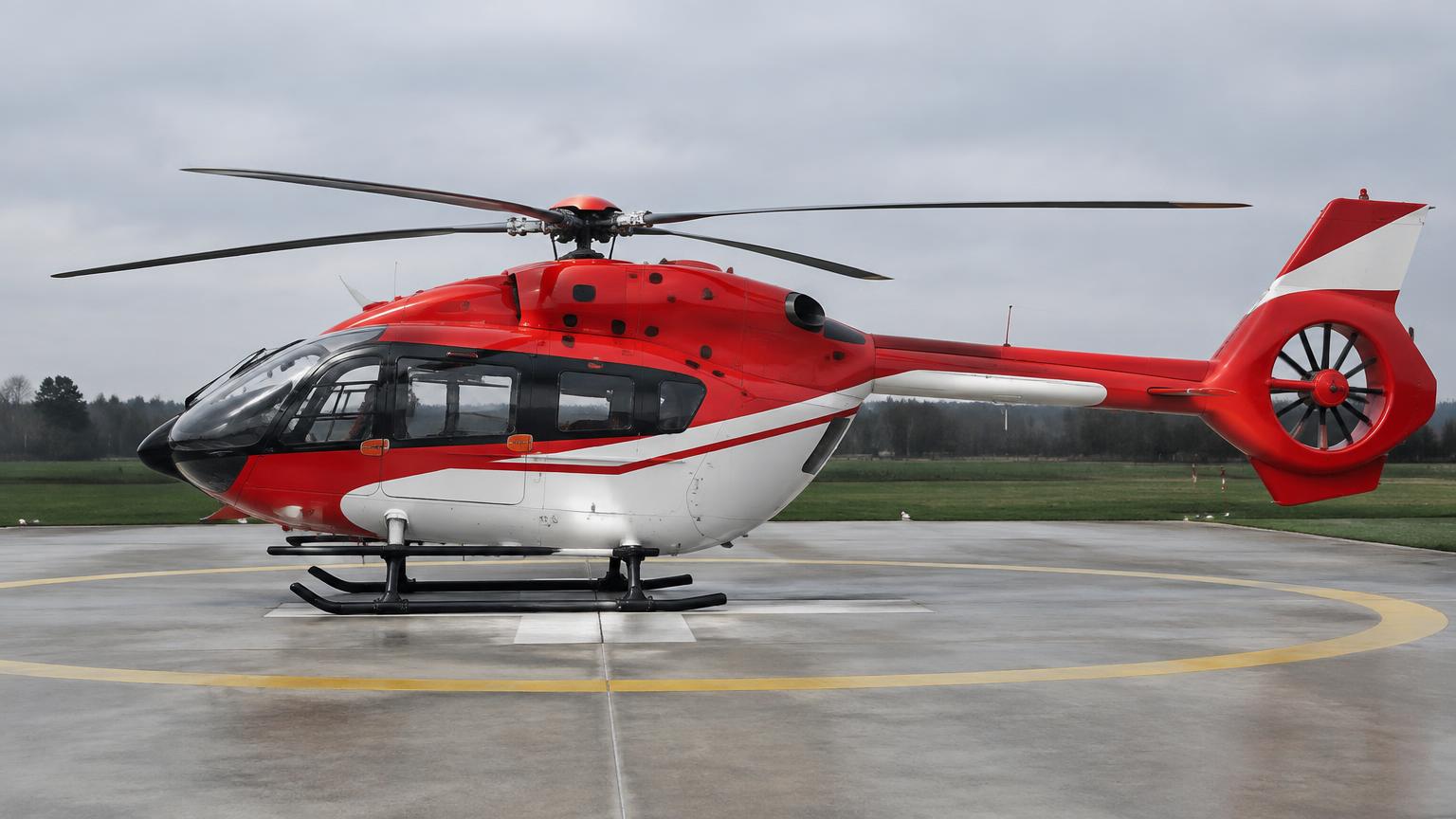
The H145 descends from the BK117, a twin-engine light helicopter jointly developed by Kawasaki (Japan) and MBB (Germany) in the 1970s. Airbus Helicopters has continually modernised the design into today's glass-cockpit H145.
A Japanese-German partnership
In the 1970s, Kawasaki Heavy Industries of Japan and Messerschmitt-Bolkow-Blohm (MBB) of Germany agreed to jointly design and build a new twin-engine light helicopter: the BK117. Each partner built major sections and had its own final assembly line, an unusual arrangement that let the type be sold and supported on two continents from the start.
Growing into a HEMS standard
As MBB became part of Eurocopter (itself later folded into Airbus Helicopters), the BK117 was steadily enlarged and modernised. The BK117 C-2, marketed as the EC145, became one of the most common air ambulance and police helicopters in Europe and the United States, prized for its twin-engine safety margin and compact size.
A military cousin: the UH-72 Lakota
In 2006 the US Army selected a militarised version of the EC145 as the UH-72 Lakota, used for training, homeland security, medevac support and general utility work rather than front-line combat. Its reliability and low operating cost made it a popular choice to free up Black Hawks for combat roles.
The leap to Helionix
In 2014 Airbus Helicopters introduced the H145 (internally the BK117 D-2), fitting the proven BK117 airframe with the Helionix digital cockpit, a 4-axis autopilot and a new bearingless main rotor with far fewer moving parts than earlier hinged designs. The five-blade H145 D-3, launched in 2019, added more main-rotor blades for better hot-and-high and single-engine performance without lengthening the aircraft.
✓ Verified official data
From the type-certificate data sheet
These figures are checked against free, public documents from the FAA and EASA. Click a source to open it.
| Item | Official value | Source |
|---|---|---|
| Type certificate | EASA.R.017 (BK117 series, including H145) | EASA — Type-Certificate Data Sheet EASA.R.017 (BK117 / H145 series) |
| Approved engines (H145 D-2/D-3) | 2 x Safran (Turbomeca) Arriel 2E | EASA — Type-Certificate Data Sheet EASA.R.017 (BK117 / H145 series) |
| Main rotor | 4-blade bearingless (D-2); 5-blade bearingless (D-3) | EASA — Type-Certificate Data Sheet EASA.R.017 (BK117 / H145 series) |
| Max takeoff weight | approx. 3,700 kg (D-2) / 3,800 kg (D-3)Confirm exact figure against the specific RFM weight variant | EASA — Type-Certificate Data Sheet EASA.R.017 (BK117 / H145 series) |
| Tail rotor | Fenestron shrouded fan | EASA — Type-Certificate Data Sheet EASA.R.017 (BK117 / H145 series) |
| Landing gear | Fixed skids (no retractable gear) | EASA — Type-Certificate Data Sheet EASA.R.017 (BK117 / H145 series) |
| Minimum flight crew | 1 pilot (SPIFR capable) or 2, depending on operation | EASA — Type-Certificate Data Sheet EASA.R.017 (BK117 / H145 series) |
Dimensions & data
| Length (rotors turning) | approx. 13.6 m |
| Main rotor diameter | approx. 11.0 m |
| Height | approx. 3.5 m |
| MTOW | approx. 3,700 kg (D-2) / 3,800 kg (D-3)✓ EASA |
| Cruise speed | approx. 135 kt |
| Range | approx. 350-400 nm (mission dependent) |
| Engines | 2 x Safran Arriel 2E |
| Type certificate | EASA.R.017 (BK117 series)✓ EASA |
Timeline
- 1977
BK117 programme launched by Kawasaki and MBB.
- 1979
BK117 first flight.
- 1987
BK117 B-2, uprated engines.
- 1987
BK117 reaches early HEMS and police operators in Europe
- 1999
BK117 C-2 introduced, marketed as EC145.
- 2002
EC145 adopted by German federal police / US Army evaluates derivative.
- 2006
UH-72 Lakota (militarised EC145) enters US Army service.
- 2006
UH-72 Lakota selected by the US Army
- 2014
H145 (BK117 D-2) launched with Helionix avionics and bearingless main rotor.
- 2014
H145 enters service with Helionix avionics
- 2019
H145 D-3 introduced with 5-blade main rotor and higher MTOW.
- 2019
H145 D-3 five-blade rotor announced
- 2020
H145M light-attack/utility military variant deliveries expand.
Variants
| Variant | Years | Engine | Key differences |
|---|---|---|---|
| BK117 A/B series | 1979-1999 | Avco Lycoming LTS101 / Arriel 1 | Original Kawasaki-MBB design; conventional 4-blade hinged rotor. |
| BK117 C-2 / EC145 | 1999-2014 | 2 x Arriel 1E2 | Enlarged cabin, Fenestron tail rotor introduced; widely used for HEMS and by German/French police. |
| H145 (BK117 D-2) | 2014-present | 2 x Arriel 2E | Helionix glass cockpit, 4-axis AFCS, bearingless 4-blade main rotor. |
| H145 D-3 | 2019-present | 2 x Arriel 2E | 5-blade bearingless main rotor, higher MTOW and hover performance. |
| H145M / UH-72 Lakota | 2014-present / 2006-present | 2 x Arriel 2E / Arriel 1E2 (early UH-72) | Militarised variants for utility, training, security and light attack roles. |
Approximate figures — verify against the type certificate data sheet and manufacturer data.
EDUCATIONAL USE ONLY. Content is summarised from manufacturer documentation for learning. It is not approved flight or maintenance data. Always use the current, aircraft-specific POH/AFM, FCOM, QRH, AMM and operator procedures.