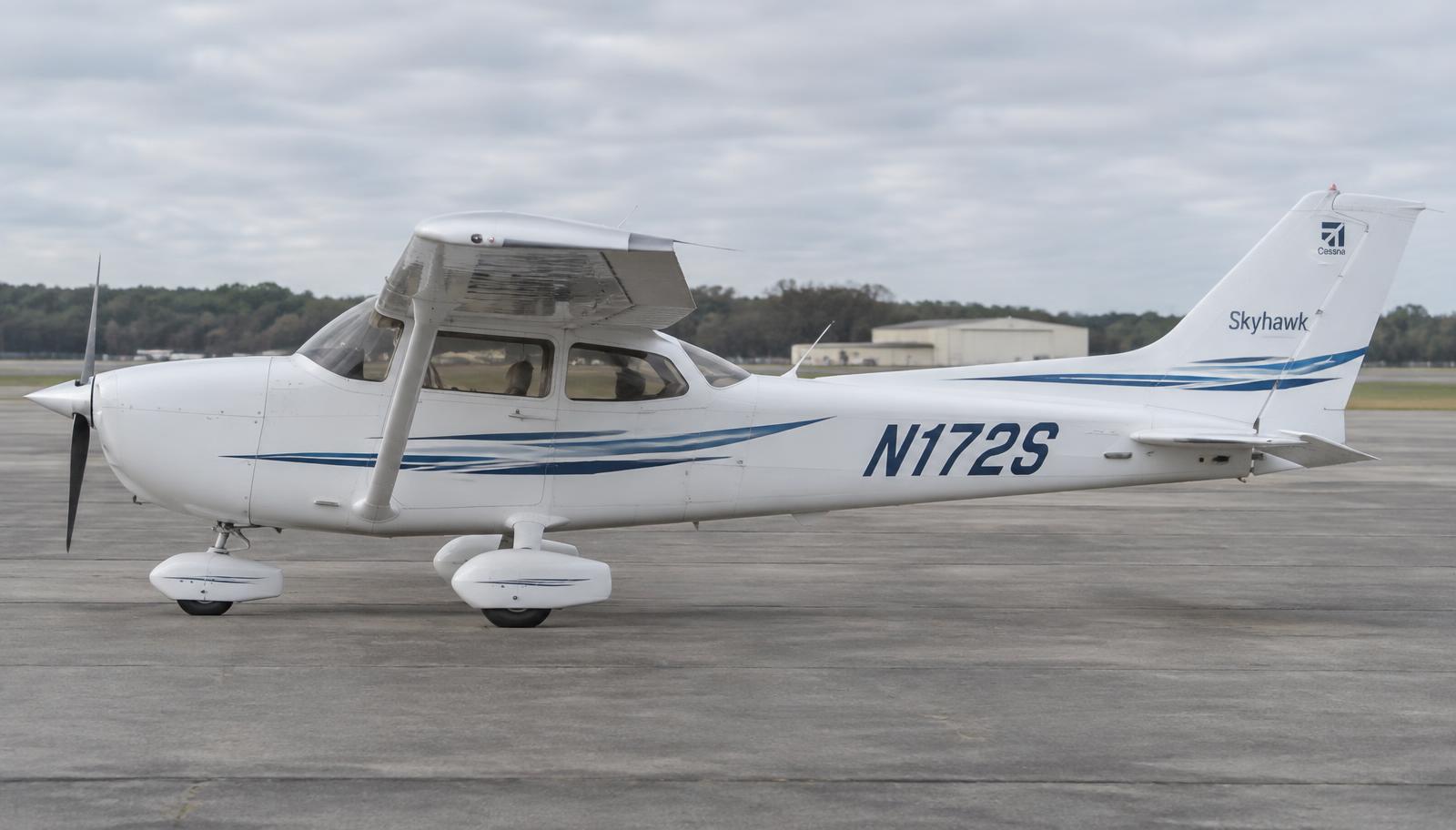
The most produced aircraft in history — the classroom of general aviation.
Unverified — check your manualText on this page is written from general knowledge. Figures marked ✓ are checked against official FAA/EASA data.See verified data
Model / variant — applicability
Years
2005 – present
Serials
172S9491 and on (G1000 installs; verify on data plate)
Engine
Lycoming IO-360-L2A, 180 HP, fuel-injected
Baseline doc
Cessna 172S Nav III POH/AFM (172SPHAUS)
✓ Guide content applies
Guide content is written for this variant.
Electric standby battery and G1000 annunciations appear in emergency checklists.
NXi upgrades change some annunciation logic — check your POH supplement list.
Always check the official manual for your aircraft — see the tab for download links.
Engine
Lycoming IO-360-L2A, 180 HP
Max takeoff weight
2,550 lb
Cruise (75%)
~124 KTAS
Fuel capacity
56 gal (53 usable)
Vno / Vne
129 / 163 KIAS
Best glide
68 KIAS
PHOTO TOUR — tap a numbered point
Illustrative AI-generated imagery — panel details may differ from real aircraft
Two-seat-abreast cockpit with either analog 'six-pack' gauges or the Garmin G1000 glass panel.
How it works
01Pitot-static system feeds the airspeed indicator, altimeter and VSI. The pitot tube is on the left wing; static port on the left fuselage side, with an alternate static source inside the cabin.
02Gyroscopic instruments: attitude indicator and heading indicator are driven by an engine-driven vacuum pump (analog models); turn coordinator is electric for redundancy.
03G1000 models replace these with AHRS and an air data computer feeding a PFD and MFD.
04Electrical: 28 V DC system with a 60 A alternator and 24 V battery; split master switch (ALT / BAT).
Key data & limitations
Where to find itPOH Section 7 (Airplane & Systems Descriptions)Check this reference in your official manual.
Electrical
28 VDC, 60 A alternator
Vacuum (analog)
4.5–5.5 in. Hg normal
Avionics
Garmin G1000 NXi (current)
Maintenance guidelines
Where to find itMaintenance manual, ATA 23 / 24 / 31 / 34Check this reference in your official manual.
Pitot-static and altimeter/transponder checks every 24 calendar months (14 CFR 91.411 / 91.413) for IFR use.
ELT inspection every 12 months; battery replacement per manufacturer or after 1 hr cumulative use (91.207).
Inspect vacuum pump and filter per maintenance manual intervals; replace central air filter as scheduled.
REF: POH Section 7 (Airplane & Systems Descriptions)
— FAA-H-8083-3 Airplane Flying Handbook; 14 CFR Part 43 Appendix D (100-hr/annual scope)
EDUCATIONAL USE ONLY. Content is summarised from manufacturer documentation for learning. It is not approved flight or maintenance data. Always use the current, aircraft-specific POH/AFM, FCOM, QRH, AMM and operator procedures.