Sections menu
Cessna 172S Skyhawk · Type data
Variants & history
Dimensions, development milestones and what changed between each version.
The Skyhawk is the most-produced aircraft in history, with more than 45,000 built. It evolved from the tailwheel Cessna 170 by adding a tricycle gear.
From tailwheel to tricycle
After the Second World War, Cessna sold thousands of light aircraft to returning military pilots. The four-seat Cessna 170 had a tailwheel, which made it tricky on the ground. In 1955 Cessna fitted a nosewheel to the 170 design, and the result — the 172 — was much easier to take off and land. It was advertised as 'Land-O-Matic', and sales took off immediately.
Growing up through the 1960s and 70s
Almost every year brought a change: a swept tail fin in 1960, a rear window ('Omni-Vision') in 1963, electric flaps, a lighter tubular steel main gear in 1971 and the Lycoming O-320 engine in 1968. The 172 became the standard aircraft of flying schools around the world. The name 'Skyhawk' was given to the better-equipped versions and later to all of them.
The pause and the restart
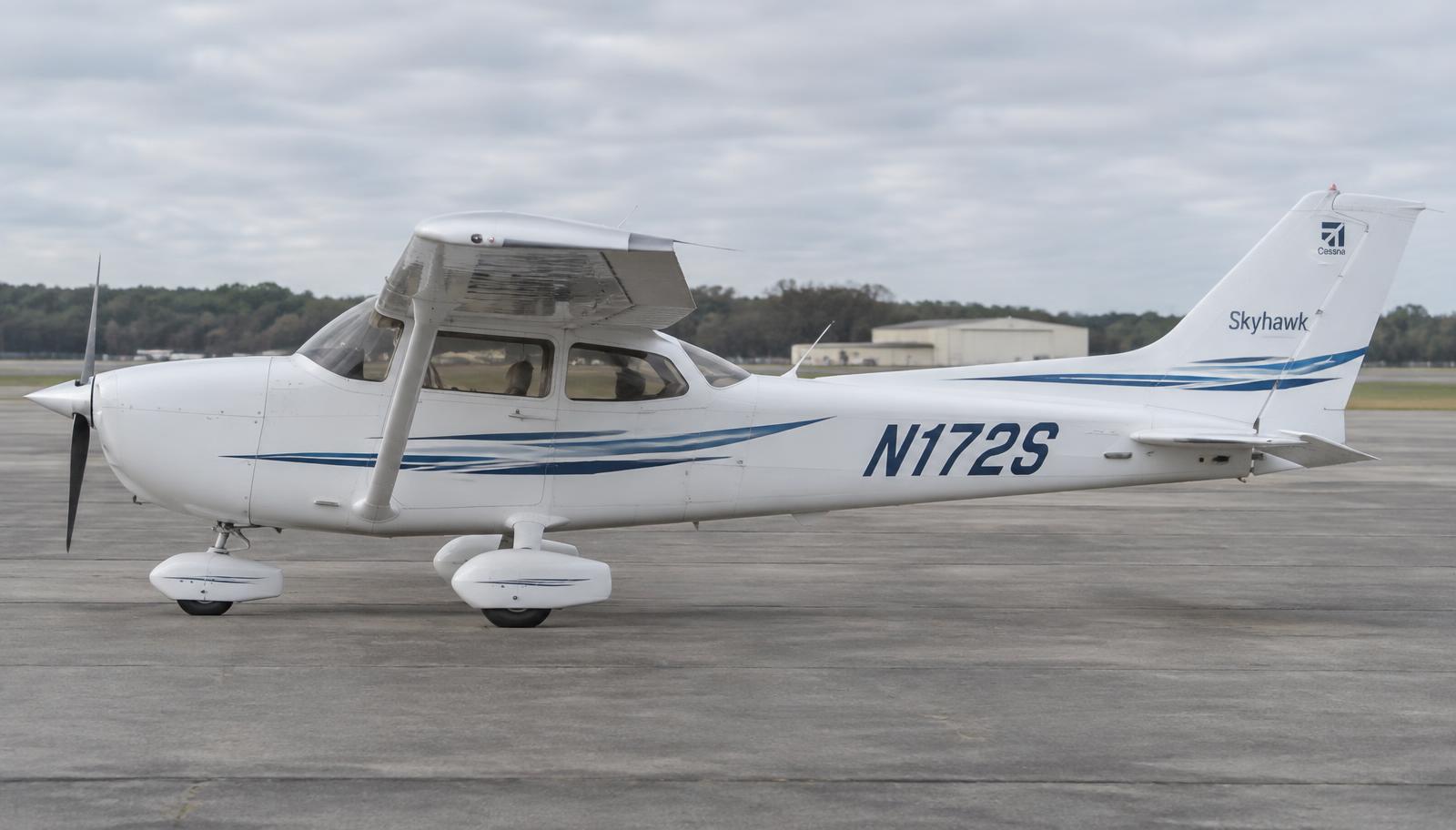
In the 1980s, product-liability lawsuits in the United States made small aircraft extremely expensive to build. Cessna stopped producing piston aircraft in 1986. After the General Aviation Revitalization Act of 1994 limited this liability, Cessna restarted production in 1996 with the 172R and, a year later, the 172S with a fuel-injected 180 hp engine.
Into the glass cockpit age
In 2005 the Garmin G1000 replaced the round dials with two large screens, a built-in moving map, engine monitoring and later an integrated autopilot (GFC 700). Training pilots on a 172 with the G1000 prepares them for the glass cockpits they will meet in airliners. Experiments with diesel and electric versions have shown where light aircraft may be heading.
✓ Verified official data
From the type-certificate data sheet
These figures are checked against free, public documents from the FAA and EASA. Click a source to open it.
Dimensions & data
| Length | 8.28 m (27 ft 2 in) |
| Wingspan | 11.0 m (36 ft 1 in) |
| Height | 2.72 m (8 ft 11 in) |
| Wing area | 16.2 m² |
| MTOW (172S) | 1,157 kg (2,550 lb)✓ FAA |
| Cruise | approx. 120–124 KTAS |
| Service ceiling | 14,000 ft |
| Type certificate | FAA 3A12✓ FAA |
Timeline
- 1955
First flight of the 172.
- 1958
Endurance record: 64 days aloft
- 1960
172A: swept fin and rudder.
- 1963
172D: omni-vision rear window, cut-down rear fuselage.
- 1977
172N: Lycoming O-320-H2AD.
- 1981
172P: O-320-D2J, flaps limited to 30°.
- 1986
Production paused.
- 1987
Mathias Rust lands a 172 in Red Square
- 1994
General Aviation Revitalization Act
- 1996
Restart: 172R fuel-injected.
- 1998
172S Skyhawk SP, 180 HP.
- 2005
Garmin G1000.
- 2010
Electric 172 demonstrator announced
- 2018
G1000 NXi.
Variants
| Variant | Years | Engine | Key differences |
|---|---|---|---|
| 172 – 172H | 1956–1967 | Continental O-300, 145 HP | Early fastback and swept-tail models; 40° flaps. |
| 172I – 172M | 1968–1976 | Lycoming O-320-E2D, 150 HP | Switch to Lycoming; cambered leading edge (M). |
| 172N | 1977–1980 | O-320-H2AD, 160 HP | 28 V electrical; H2AD cam issues. |
| 172P | 1981–1986 | O-320-D2J, 160 HP | Flaps 30°; wet wing option. |
| 172R | 1996–present | IO-360-L2A, 160 HP | Fuel injection, new interior, crash-resistant seats. |
| 172S | 1998–present | IO-360-L2A, 180 HP | Higher MTOW, G1000 from 2005. |
Approximate figures — verify against the type certificate data sheet and manufacturer data.
EDUCATIONAL USE ONLY. Content is summarised from manufacturer documentation for learning. It is not approved flight or maintenance data. Always use the current, aircraft-specific POH/AFM, FCOM, QRH, AMM and operator procedures.